


National Merit Scholarship Program
About 16,000 of 1.3 million+ entrants
adrian.os is down for maintenance. Back online shortly.
erlikhman.adrian@gmail.comi'm a senior in los angeles.
i build ML and full-stack tools for people.
i do ML / NLP research.
i fence épée for team usa.
 adrian erlikhman · los angeles
I'm a high school senior at the Los Angeles Center for Enriched Studies, and I'm applying to college this fall. My interests are in applied machine learning, quantitative finance, and data science, a world I got into by sending hundreds of cold emails until a few of them turned into internships.
I want to build things that actually make a difference, and I'm always open to learning new things.
Climbing, backpacking, cycling, surfing, and swimming in freezing lakes.







 Firstness ↗ · AI research engine
Software and ML engineering on the Firstness AI platform, working directly under the founder. My work has two parts: refining how the platform connects into the research stack (the literature databases and reference managers researchers already work in), and making it easier for new users to understand, with demos that walk them through how it works. Firstness is a research engine for discovering new hypotheses: it grows a question into a map of branching ideas, writes each answer from the peer-reviewed literature with a citation on every sentence, and checks a new hypothesis against published prior work.
 Kiddom ↗ · K–12 EdTech
Designing machine-learning and NLP approaches to teacher-facing problems in K–12 assessment, with Kiddom’s Director of Data Science: which problems are worth modeling, what student data a school can realistically share, and what result would count as evidence rather than a demo. I built Why Wrong against one of them — it reads a class’s answer sheets, names the misconception behind each wrong answer, and groups the class by shared mistake — and I’m designing its classroom evaluation with an LAUSD teacher: a review of the item bank, a pilot on de-identified responses from one class, then a written comparison of where the tool and the teacher agree and where they don’t.
Diligence on 20+ early-stage AI startups, and 10+ full investment memoranda — market sizing, competitive positioning, technical architecture, founder evaluation — written for partner-level decisions. Led the screen of Y Combinator's Summer 2025 batch with Managing Director Tatiana Janko, and drafted the monthly LP updates.
Built the Alliance's 250+ firm investor database in HubSpot — VCs, angel syndicates, accelerators — and led the backend redesign of the pipeline infrastructure with the Chief Innovation Officer. Defined the schema it still sorts on (org category, funding stage, location, point of contact) and rewrote the intake form founders fill out, so inbound companies could be routed to partners like Expert Dojo and the Long Beach Accelerator. Maintained the life-sciences segment the review process runs on, tracking rounds as they closed, and sat in on the SVP Life Science pilot committee's pitch reviews.

A 21-feature classifier names the model 59–72% of the time in all seven languages, against 20% chance. Asked the same question, the models score 20–25%.
Attributing text to a specific model has been studied almost only in English. We collect 840 essays from five frontier models (GPT-5.5, Claude Opus 4.7, Gemini 3.5 Flash, Grok 4.3, DeepSeek V4 Pro) in seven languages from English to Hindi, and attribute them with 21 interpretable features computed from Universal Dependencies parses. A five-way classifier reaches 59–72% in every language against 20% chance, and we detect no decline as a language's resources fall. Character n-grams are more accurate within a language, but the interpretable features transfer between languages better (49% against 41%). Attribution holds at 57–70% on machine-translated text, while the five models, asked which of them wrote each text, score only 20–25%.
RewardBench's leader survives the removal of any 11 of its 2,985 items. Removing 12 particular items makes the runner-up the winner.
Automated research and self-improvement pipelines pick a reward model or LLM judge by its accuracy on a validation set, and that set is often curated by the pipeline or its designers. The paper's curation certificate says how much of the set could be removed before the winner changes. In benchmark weight it is at least the gap between the top two models; in items it is exact, from one sort per challenger. Linear programs show the bound is tight near the top of RewardBench (118 models) and RewardBench 2 (188). RewardBench's leader survives any 11 removed items, and RewardBench 2's any 42. On 200-item RewardBench validation sets, picks whose top two are more than 2 points apart match the full-benchmark winner 87% of the time, against 43% for the rest.
The usual test flags self-recognition in 15 of 37 cases. 8 survive a false-alarm control, 3 beat the pooled peers, and none beats its strongest single peer.
LLM judges are anonymized on the assumption that they cannot tell who wrote a text. The usual check is whether a judge names itself on its own writing more often than chance. We add two controls from the same experiment: how often the judge names itself on text it did not write, and how often the other judges name it on its text. Across nine judges, 1,270 texts and over 19,000 judgments, the usual check flags 15 of 37 cases. In 7 the judge names itself as often on others' text. Of the other 8, all frontier models, 3 beat the pooled peers and none beats its strongest single peer: Claude names itself on 33 of its 38 chat-app essays, and GPT names Claude on 32. The authorship signal is in the text (a style classifier attributes 86% of the essays); the judges' answers do not follow it.

Splitting evenly beat the Markowitz portfolio in 74% of 250 calibrated simulations (Sharpe 0.70 against 0.51).
Modern portfolio theory says to hold assets in the proportions that maximize reward-to-risk — the Markowitz portfolio. We compare it to simply holding equal amounts of each asset (1/N) on a factor model calibrated to real market data. Across 250 simulations the 1/N portfolio earns a higher Sharpe (0.70 vs 0.51) and wins 74% of the time, a gap worth about 3 points of return a year at the same risk. Given the true covariance but estimated means, the optimizer still loses; given true means, it is nearly optimal. Estimating expected returns is the whole problem, and shrinkage only fixes it with about two decades of stationary data.
The ranking holds as a whole (median Spearman ≥ 0.99) but not mid-table, where the median 90% rank interval spans 36 places.
The Legatum Prosperity Index ranks 167 countries by an equal-weighted mean of twelve pillar scores. We reproduce every published score and rank exactly, then vary the weights, normalization and aggregation: 10,000 draws under each of three weight priors and a 131,072-run Sobol' design. The ranking holds as a whole (median Spearman ≥ 0.9899) but not in mid-table: the median 90% rank interval is 22 places overall and 36 for ranks 68–100. The paper's new result is rank leverage, c²(1 − ρ²): a weight can reorder countries only through the share of its pillar's variance that the composite doesn't share, times the pillar's squared relative spread. With arithmetic aggregation it tracks the weights' total effects under all four normalizations (Spearman 0.91–0.99), and equal weights of 1/12 give leverages that differ sixfold.
Ongoing study of induction, number theory, combinatorics, and game theory with a PhD mentor, applied to algorithmic problem-solving and computational mathematics. My working session notes are below.
 A26 · highest USA Fencing rating awarded | Épée | Team USA | LA International Fencing Center

 Div I pool win · vs. a Harvard fencer
 Div I pool win · vs. a UCSD fencer
Awards, founding roles, invitations and coursework.

Lovable × United Nations · eDNAtlas, a live map that scores coastal sites from environmental DNA ↗

Hacker Fund × City of LA Vision Lab · Council District 9 Champion, Under 18, for Ledger ↓

Young Coders’ Sphere · third internationally, for Safe Routes to School ↓
About 16,000 of 1.3 million+ entrants

Top 8 of 45 teams with “dunerscore”, a Python tower-defense bot built by a team of three · Citadel | Citadel Securities, hosted by Correlation One

Sub-5% acceptance, $30,000+ in partner credits

aiEDU’s student panel on AI · National Consortium of STEM Schools, San Diego, December 2026

A $10,000 district challenge

A simulated portfolio on live data, against thousands of teams
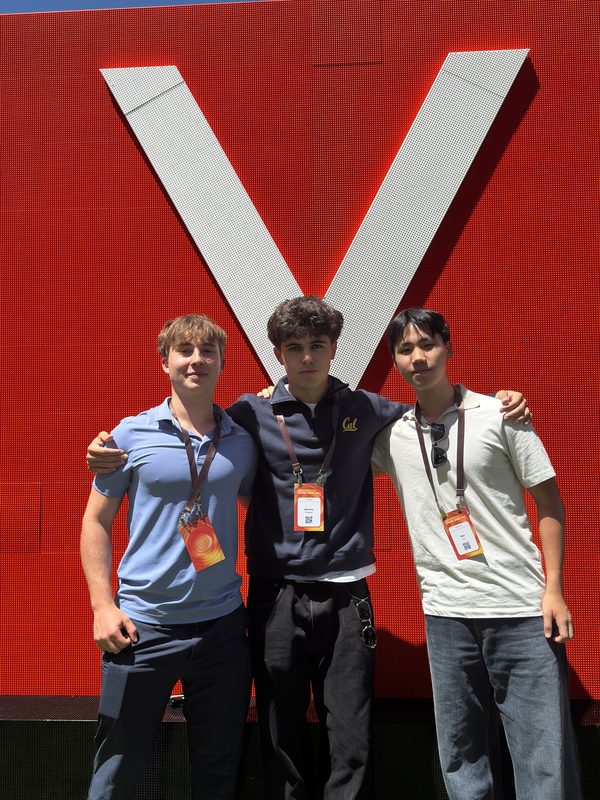
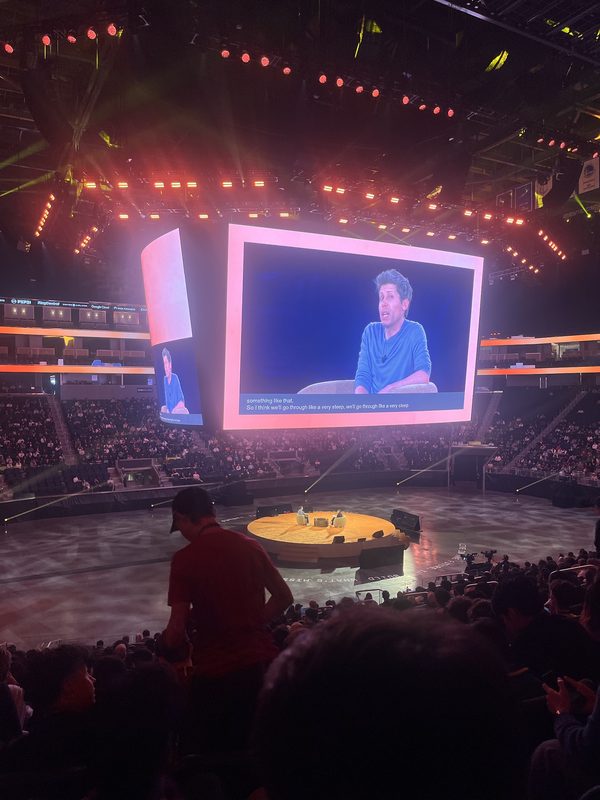
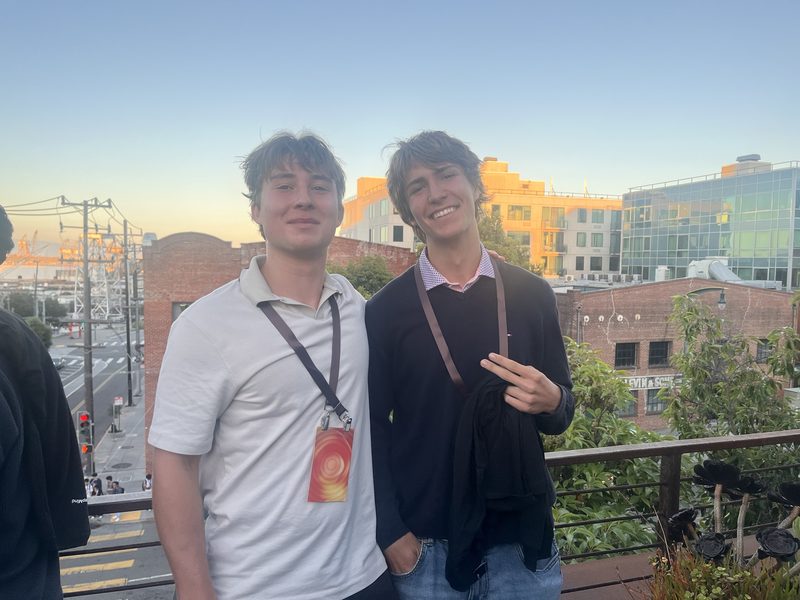
 SafeJew · JFEDLA Teen Innovation Grant · 800 geolocated incidents across Greater LA, and a scraper that keeps the map current ↓
Co-founderAI & Machine Learning Literacy Initiative · a free AI curriculum for LA public schools, and a summit for 200+ students ↓
SafeJew · JFEDLA Teen Innovation Grant · 800 geolocated incidents across Greater LA, and a scraper that keeps the map current ↓
Co-founderAI & Machine Learning Literacy Initiative · a free AI curriculum for LA public schools, and a summit for 200+ students ↓
 5.2 weighted GPA · 1520 SAT · AP Scholar with Distinction, on a 17-AP course load: 11 exams taken, 6 this year
 Kaggle × Google Gen-AI Intensive · five days on LLMs, embeddings, prompting and agents
 Deep Learning Specialization · Andrew Ng, DeepLearning.AI on Coursera · five courses: neural nets, optimization, CNNs, sequence models
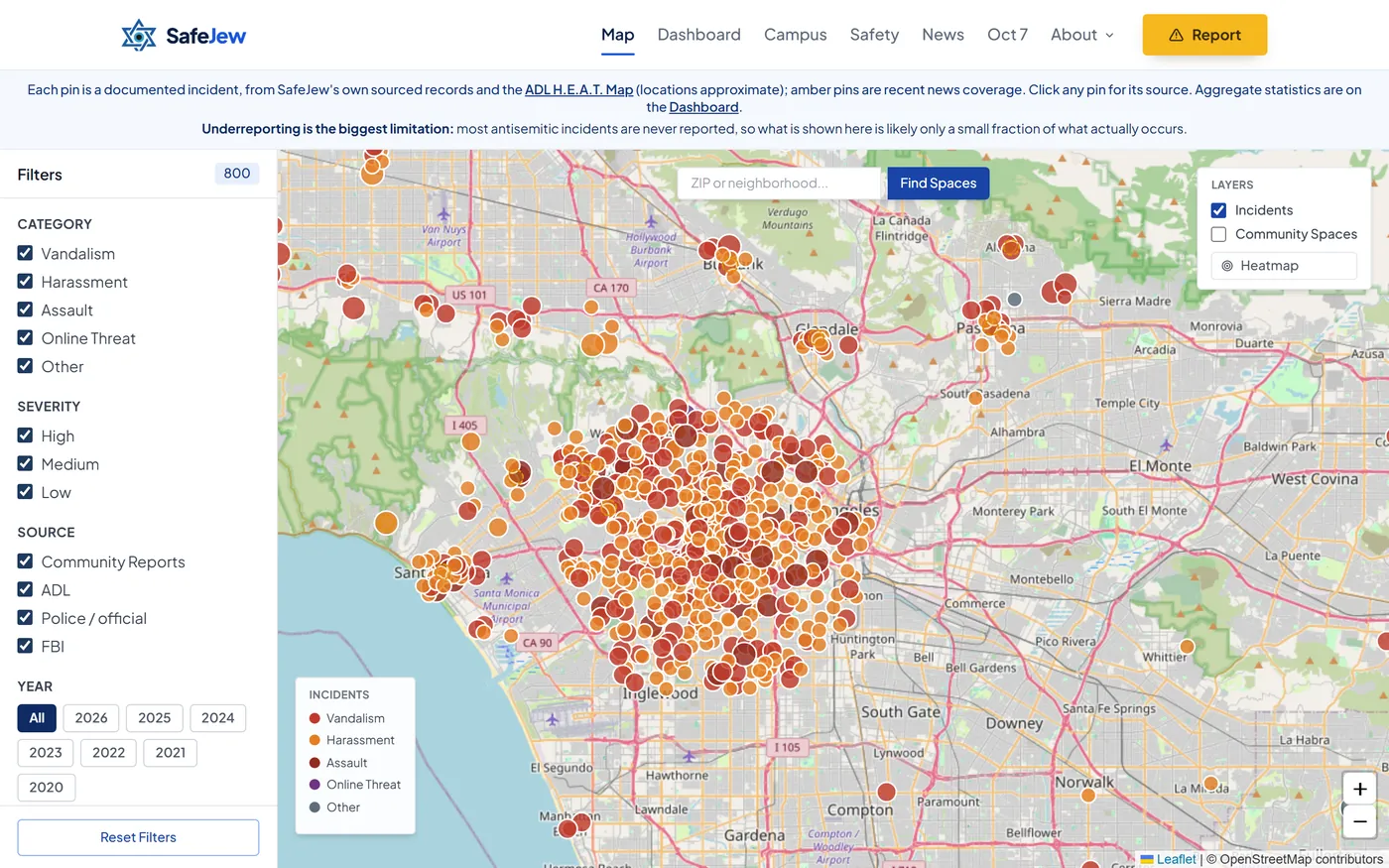 SafeJew·co-founder·2024–present
A model screens scholarship applicants. Make the scholarship rarer.
The course’s Unit 1 notebook, pooled over 25 draws of 400 applicants.








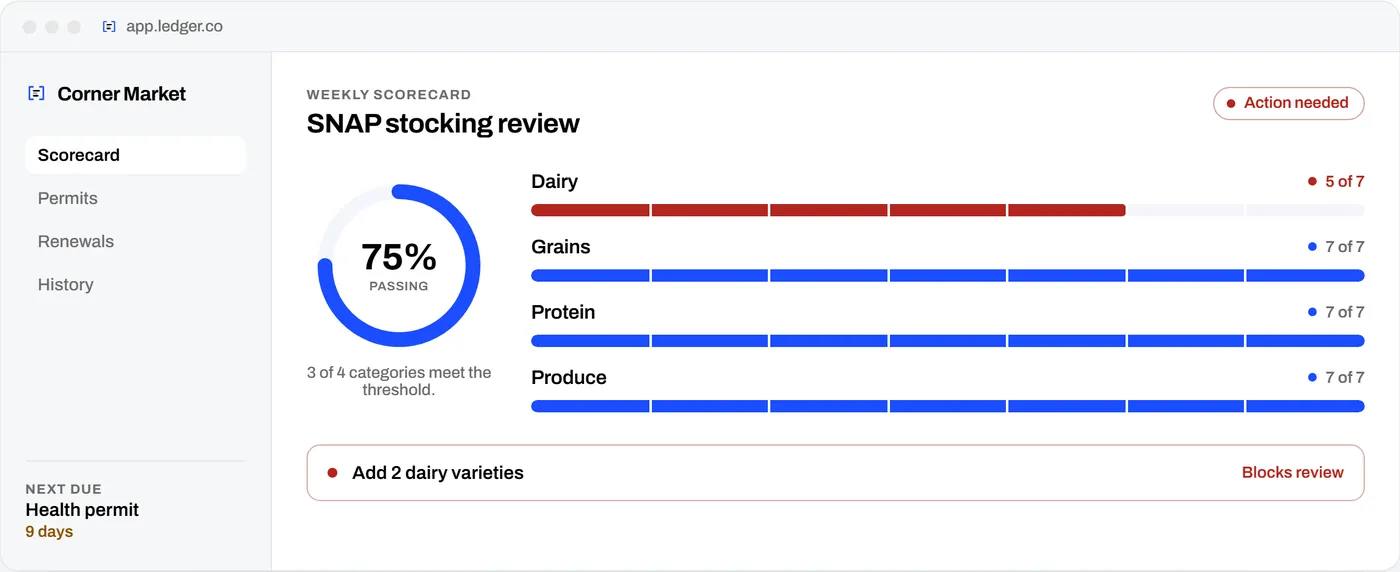
Each line is counted or held back with a reason, then each category is scored against the SNAP rule.
Synthetic records from Ledger’s test suite. This shows the rule engine, which matches hand scoring on all 24 records with no false passes, not the vision model, whose accuracy on real photos hasn’t been measured. The eval ↗

 GitHub
 LinkedIn